
A new idol of Ram Lalla sculpted by Mysuru-based Arun Yogiraj has been selected for installation at the Ram temple in Ayodhya, temple trust's general secretary Champat Rai said on Monday.
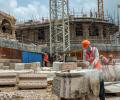
Taking note of the expected rush for the ceremony, divisional commissioner Gaurav Dayal on Wednesday convened a meeting of hotel owners of Ayodhya in preparation and instructed them to decorate their hotels to give a warm welcome to their guests during the consecration ceremony.

'The locals want a permanent solution to the perennial Mandir-Masjid issue. They have realised political parties will lose relevance if a temple is built.'
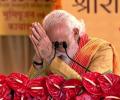
Beginning his speech with 'Jai Siya Ram', the prime minister told the gathering that a grand temple will now be built for 'Ram Lalla', the infant Ram, who had been living in a temporary tent for years.
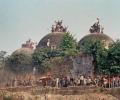
A special judge holding trial in the Babri Masjid demolition case, involving Bharatiya Janata Party veterans L K Advani, M M Joshi and others, on Monday moved the Supreme Court seeking six more months to conclude the trial in the case.

Top BJP leaders hailed the special CBI court order acquitting all the accused and described it as a victory of truth and justice.
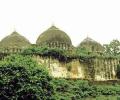
On October 5, 2019, the sessions court hearing the matter had said that as per Supreme Court orders, all evidence has to be presented before December 24, 2019, which would be the last working day.
The Vishwa Hindu Parishad on Sunday inaugurated its controversial yatra from Ayodhya amidst a massive crackdown launched by the Uttar Pradesh administration which has arrested senior VHP leaders Ashok Singhal and Praveen Togadia, and over 500 people.

The Supreme Court on Tuesday sought responses from Bharatiya Janata Party veteran L K Advani and others leaders on a plea against dropping of criminal conspiracy charge against them in the Babri mosque demolition case.
In the recent past, Adityanath and the RSS seem to have come closer. The warmth is more on the part of the RSS. And even now, not all requests from the RSS are accommodated by the UP government, points out Aditi Phadnis.

Here are the key figures among the 32 accused in the Babri mosque demolition case who were on Wednesday acquitted by a special CBI court in Lucknow of all charges.
The Supreme Court is likely to pronounce its verdict on Wednesday on a plea seeking restoration of conspiracy charges against senior Bharatiya Janata Party leaders, including Lal Krishna Advani, Murli Manohar Joshi and Uma Bharti in the Babri Masjid demolition case.

Justice V Gopala Gowda recused himself from the hearing without citing any reason and said, "let the matter be placed before the Chief Justice" for its allocation to some other bench.
The Supreme Court on Monday kept its options open on examining the dropping of conspiracy charge against accused like L K Advani, M M Joshi and Uma Bharti in the demolition of the disputed Ram Janmabhoomi-Babri structure in Ayodhya in 1992.
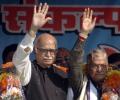
The SC asked special judge to control the proceedings in accordance with law so that inordinate delay that is beyond the time-frame is no longer breached.
The CBI court also ordered framing of charges against the accused in light of the Supreme Court order dated April 19, 2017.
The apex court will also decide whether the trial of the VVIP accused can be transferred from a court in Rae Bareli to Lucknow.
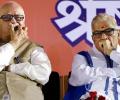
The top court, which had earlier fixed August 31 as the deadline for completion of proceedings including pronouncement of the verdict, took note of the report filed by special judge S K Yadav in the high-profile case.
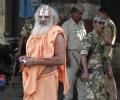
The twin towns of Ayodhya and Faizabad were on the edge on Saturday as tension mounted on the eve of VHP's yatra with the UP government cracking down on the saffron outfit arresting some of its leaders and over 350 activists.
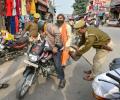
The Vishwa Hindu Parishad has too decided against observing the 27th anniversary of the demolition as "Shaurya Diwas".
The court also observed that late Vishwa Hindu Parishad leader Ashok Singhal wanted to save the structure because Ram idols were inside.

Uneasy calm prevailed in Ayodhya, which on Saturday looked like a fortress, with deployment of more than 10,000 cops on the 22nd anniversary of the demolition of the Babri Mosque.

There are indications that the Modi dispensation was disinclined to bring the VHP into the temple-mosque frame.

'He couldn't hold himself from chanting 'Siyavar Ramchandra ki Jai'.'

The event brings to fruition the Bharatiya Janata Party's 'mandir' movement that defined its politics for three decades and took it to the heights of power.
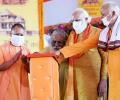
'Mohan Bhagwat is very upfront with his views and arguments.' 'Mohan Bhagwat is competent to deal with Modi's personality cult.'
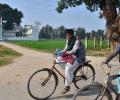
Iqbal Ansari, one of the main plaintiffs who fought for the right of the community over the disputed land, says Muslims in Ayodhya won't be satisfied if the Sunni Waqf Board accepts the five acres in Dhannipur.
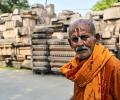
'Gods of different religions haven't warred, so we shouldn't either.'
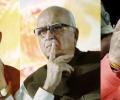
The apex court, however, noted that Rajasthan Governor Kalyan Singh enjoys Constitutional immunity and can be tried only after he ceases to hold the office.
